

What is Agentic AI? Why real value only emerges through custom integration








Key takeaways:
- Agentic AI describes AI systems that do more than generate content. They pursue goals, plan multiple steps, and work toward outcomes.
- In companies, Agentic AI does not work out of the box. It only creates value when processes, data, workflows, and systems are meaningfully integrated.
- Agentic AI integration and custom AI solutions matter because high-value use cases are almost always company-specific.
Anyone working with AI right now will quickly come across a term that is appearing more and more often: Agentic AI. It refers to systems that do more than generate content or answer questions. They can independently carry out multiple steps in pursuit of a defined goal. This is especially relevant for companies because it shifts the focus away from pure assistance and toward AI that is actively embedded in operations and can create real operational impact.
What is Agentic AI?
Agentic AI refers to AI systems that do not simply react to prompts, but work toward a defined goal and can independently carry out multiple steps to achieve it. Unlike traditional generative AI, which primarily creates content or answers questions, Agentic AI can interpret information, prepare decisions, plan actions, use tools, and drive outcomes forward along a workflow.
Core characteristics of Agentic AI include:
- Goal orientation
- Multi-step planning
- Reasoning
- Tool use
- A certain degree of autonomy
For companies, this distinction matters. A model usually delivers an answer to a prompt. An agentic system, by contrast, pursues an outcome: it analyzes context, breaks tasks into smaller steps, accesses relevant information or applications, and moves forward along a process. That is exactly why Agentic AI is becoming so relevant for enterprise use cases: not as a better chat interface, but as an approach for purposefully supporting complex, multi-step workflows.
It is also important to distinguish the terms clearly: an AI agent is usually a single operational unit with a specific task. Agentic AI describes the broader approach or the system behind it, meaning the coordinated, goal-oriented execution of tasks by one or more agents in connection with data, rules, and applications.
In short: Generative AI produces content. Agentic AI works toward outcomes.
Agentic AI vs. Generative AI
The difference between Generative AI and Agentic AI lies primarily in the depth of execution.
Generative AI is designed to create content based on a prompt. This includes, for example, texts, summaries, code, images, or analyses. It responds to an input and delivers an output.
Agentic AI goes one step further. It does not merely process information, but can structure tasks, plan intermediate steps, call tools, incorporate data from different sources, and act toward a defined goal. This shifts the benefit from pure content generation to operational support.
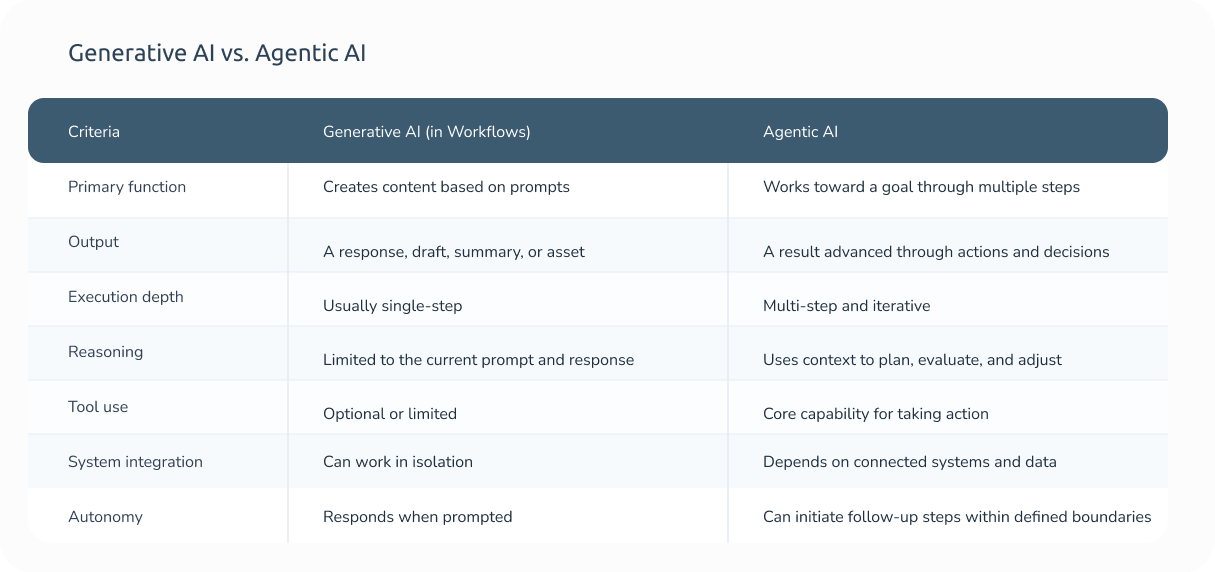
For companies, that is exactly the decisive point. What makes the difference is not the quality of a single answer, but the ability to integrate AI meaningfully into real workflows.
Why Agentic AI does not work out of the box
Precisely because Agentic AI is designed for outcomes rather than just answers, it does not work in practice as a standard off-the-shelf product. An agent can only become effective when it is connected to a company’s relevant data sources, applications, rules, and process steps.
An agent is not a product that can simply be introduced. It is always part of a system.
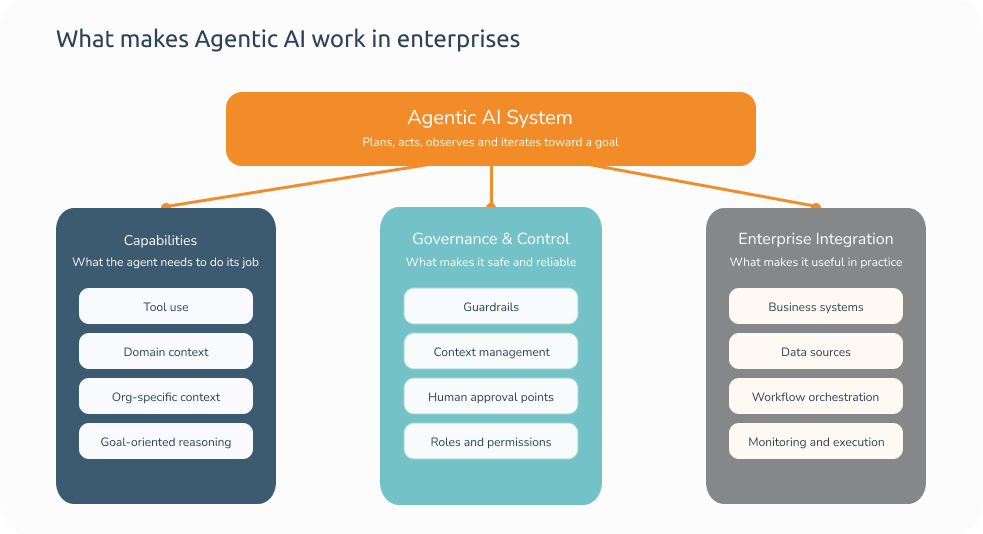
This also explains why many initial implementations are impressive at first glance, but rarely productive right away. As long as an agent is demonstrated only in isolation, the very elements that matter for real-world use are usually missing:
- Reliable data access
- Role and permission concepts
- Interfaces to existing systems
- Process logic
- Clear boundaries for automated decisions
The bottleneck therefore usually does not lie in the model itself, but in its connection to the real working environment.
The real success factor? Custom integration!
The core issue is this: Agentic AI integration is not a secondary technical task, but the actual success factor.
For an agent to work productively, it takes more than a powerful model. What matters is its integration into existing systems, data flows, and decision logics. This includes, among other things, connections to specialist applications, structured access to relevant information, the consideration of internal approvals, and orchestration that brings together business logic and technical execution.
Most of the work happens outside the model itself: processes need to be understood, data needs to be made usable, interfaces need to be built, systems need to be connected, and decision-making scope needs to be clearly defined.
Custom integration is therefore not a technical add-on, but the prerequisite for Agentic AI to function reliably in a business environment in the first place.
Valuable use cases are almost always custom
The closer you get to real value creation, the more obvious another point becomes: relevant Agentic AI use cases are almost never generic.
At first glance, many use cases may look similar. Customer service, sales support, bid management, IT support, or document processing exist in many organizations. In implementation, however, they often differ fundamentally. Data sources, responsibilities, approvals, system landscapes, and decision rules vary from one company to another. Precisely because Agentic AI works along concrete goals and processes, this difference becomes relevant immediately.
The closer a use case is to real value creation, the less sufficient a general standard approach becomes. That is exactly why Agentic AI is almost always custom in practice.
Agentic AI in logistics
This becomes particularly tangible in logistics, for example in dispatching and disruption management. An agent can continuously analyze transport orders and status data, detect delays early, suggest alternative actions, and proactively inform affected customers.
However, the real value only emerges when this agent is deeply integrated into the existing work environment. To do that, it must be able to access real-time data from transport, tracking, and planning systems, understand existing dispatching rules and priorities, and interact with operational systems. Escalations and decisions must also be managed carefully in coordination with the responsible human stakeholders.
Only then does an isolated function become a productive use case. This is exactly what shows why Agentic AI in logistics is compelling not because it automates individual steps, but because it can support dynamic processes in a context-aware way, embedded in real systems, data, and rules.
Agentic AI + custom integration = real value
Agentic AI is so exciting for companies because it enables the move from pure content generation to goal-oriented execution. Its value does not lie in autonomy alone, but in its ability to fit into real business operations in a controlled and meaningful way.
It does not make the difference as an isolated product, but as a custom-integrated system. Real value emerges where AI is connected with processes, data, applications, and responsibilities. This is exactly the point where technological potential becomes operational impact.
More about „Artificial Intelligence“





Stay at the Pulse of Digital Innovation
Subscribe to our newsletter and get the latest articles, innovations, and best practices in Energy, Mobility & beyond – straight to your inbox.
Stay at the Pulse of Digital Innovation
Subscribe to our newsletter and get the latest articles, innovations, and best practices in Energy, Mobility & beyond – straight to your inbox.